Resources

Free guides, skills, and templates for founders learning to use AI inside their business.

These resources are graded by complexity and best worked through in order. If you're new to AI, start at the top. By the time you reach the advanced section, you'll have lived enough of the principles to actually apply them. Each one is free. Drop your email and we'll send the file (or notify you when it lands).
01

Beginner

Start here
Guide Available now

Getting Started with AI

A plain-English starter for founders who haven't used AI for real work yet. What it is, what it isn't, where it earns its keep in a small business, and where it doesn't. No jargon, no hype.

What's inside Mental models for what AI actually does, the three jobs it's good at right now, the three jobs to avoid, a 30-minute first-use exercise you can run today.
Best for: complete beginners · read online

Reading list Available now

Background Reading & Resources for Beginners

The curated list we wish someone had handed us when we started. Books, essays, talks, and tools, ordered by where you are now. Skip the noise.

What's inside Around 25 hand-picked items grouped by stage: what to read in your first week, your first month, and once you've shipped something. Each entry has a one-line "why this matters" note.
Pair with: Getting Started · read online
02

Intermediate

You've used it for real
Guide Available now

Safety & Security Considerations for SMEs

The bits no one warns you about until something goes wrong. Prompt injection, data leakage, secrets handling, prompt-routing tiers, what to put in your DPA. Written for owner-operators, not security teams.

What's inside The six-surface threat map we use on every build (secrets, privacy & data, prompt injection, attack surface, backup & rollback, external platform config), with a worked example for each. Plus the "never persist secrets" rule and why.
PDF · 17 min read · 4,250 words · read online
Guide Available now

The Forge Method

Our project methodology for shipping AI tools without bloat. Five phases (Shape, Build, Ship, Sustain), four gates, a seven-point waste audit, and the discipline to stop half-shipping. Used on every AbsoLabs build.

What's inside Why the methodology exists (the failure modes Forge prevents), what the phases and gates are (with checklists), how to run it tomorrow on your next project, plus the 7 Fatal Patterns audit for technical builds and four worked examples from real AbsoLabs projects.
PDF · 18 min read · 4,500 words
03

Advanced

Operator-level
Guide Available now

Claude Operating Principles

Twenty-four cross-cutting principles for working with Claude (or any frontier LLM) as a real collaborator. Distilled from a year of running Claude as a daily co-worker on real businesses. Broken into sections, with the "why" behind each before the "how".

What's inside Eight sections: Behaviour & autonomy, Documentation & records, Project & methodology, Delegation & routing, Estimation, Security, Agent evolution, Closing & feedback loops. Each principle: the rule, why it exists, how to apply it tomorrow.
For: daily Claude users
Skill Available now

The Obsidian Vault Setup

A free, MIT-licensed AI skill that scaffolds an Obsidian vault as your company's long-term memory layer. Every future AI session reads it first. Built from the same Client Knowledge Base pattern we use internally for our own agent fleet.

What's inside Three skill zips on a GitHub Release (install + open-project + close-project), the vault schema (concepts / entities / clients / projects / _inbox), the index pattern, the session-start and session-close rituals, and the AGENTS.md hook that wires it into Cowork, Claude Code, Codex, or opencode.
Free skill (MIT) + 19-min PDF guide · v1.2.1 (Jun 2026) · ~25 min to first useful state
Guide Available now

Hermes as Slave Agents to Claude

How to run a fleet of cheaper, narrower agents underneath Claude as the conductor. Cron-fired, single-purpose, structured outputs. The pattern that lets a one-person business run twelve concurrent workflows without staffing up.

What's inside The Cowork / Hermes division of responsibility, routing tiers for data sensitivity, how to brief a sub-agent so it doesn't drift, the cowork-backlog and operator-inbox patterns that close the loop, and an end-to-end worked example following Lib (our capture worker) through a real recurring job.
PDF · 19 min read · 4,750 words
Guide Available now

Liars and Validators: How to Bulletproof Your Agentic Content

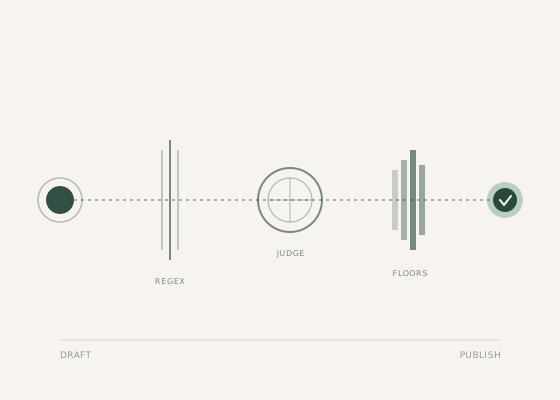
LLMs lie. Confidently, by design. The answer isn't a better prompt. It's a structured validation layer that catches the lies before they ship. The pattern we use on every AbsoLabs build to keep agentic output publishable.

What's inside The two-gate validation pattern (deterministic regex + LLM judge), per-dimension floors that catch strong composite scores hiding weak fundamentals, the fabricated-attribution and KILL LIST patterns we ban, the cross-judge rule, and operator override as the escape valve when the gates are wrong.
For: operators shipping agentic output

Missing something you'd like us to write?

Suggest a resource. If it helps other founders, we'll add it to the queue.

Suggest a resource